Create a Component Mass Balance Analysis Case
The Component Mass Balance Analysis Rule requires that an initialization Case exist if there are inventory (tank) elements in the model. This is due to tank elements having a delta inventory calculation that uses the calculated mass from the previous case. In addition, the General Gross Error Analysis, which can be called by this analysis, performs checks on several properties that compare the previous Case with the Case being calculated.
If there are no inventory elements in a case, the Component Mass Balance Analysis can be run without a previous Case selection.
Before creating cases, check the [Analysis Rules and Time Rules](/DocumentDepot/DocSFHub/docs_2026/docs-sf-system/ANALYSIS-RULES/Analysis%20Rules%20and%20Time%20Rules/choose-an-analysis-rule) topics, and configure a time rule for this Model Analysis.
To configure the Component Mass Balance Analysis Rule case, follow the steps below using either the System Explorer or the Modeler.
Follow the steps under either System Explorer or Modeler.
In the Model Analyses navigation pane, select the Model analysis for which you are creating a case.
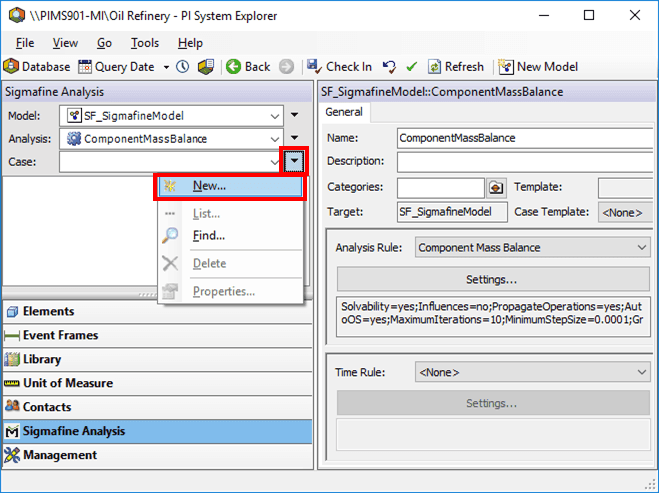
Click the Case
 menu button and select New.
In the display with the Model for which you configured an analysis:
 System Explorer
- On the SF Analysis Toolbar, click the New Case button.

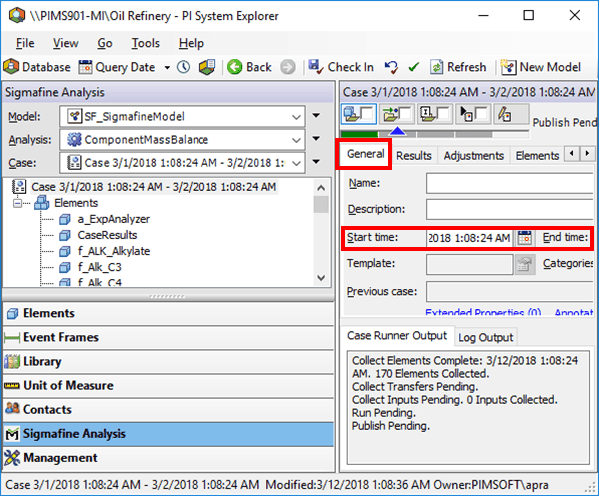
Use either System Explorer or Modeler to change the times for the Case to match a Case for the source analysis (Mass or Volume Analysis).
This manual change of times is necessary to start the Case series.
For detailed instructions on changing the times, \see the topic under Server & Client.
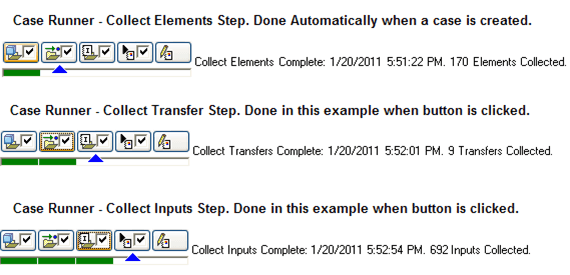
Use the Case Runner to run the Collect Elements, Collect Transfers and Collect Inputs steps, as shown in the following image.
If the Model has inventories with no analyzers attached, you must initialize the components for these tanks.
See the Initializing Components for Self-Calculated Inventory \topic for details.
Check-in the Case or continue on to create subsequent cases.
After the first case, Sigmafine uses the established Time Rule to automatically assign start and end times to the subsequent cases.
To create more cases, follow the same procedure as described above to create the first case. If you examine the Case properties of this new case, note the previous Case as the initial Case described earlier.